Showing posts with label Denmark. Show all posts

Thursday, March 31, 2022

Armorial Tapestries at Kronborg Castle: King Oluf


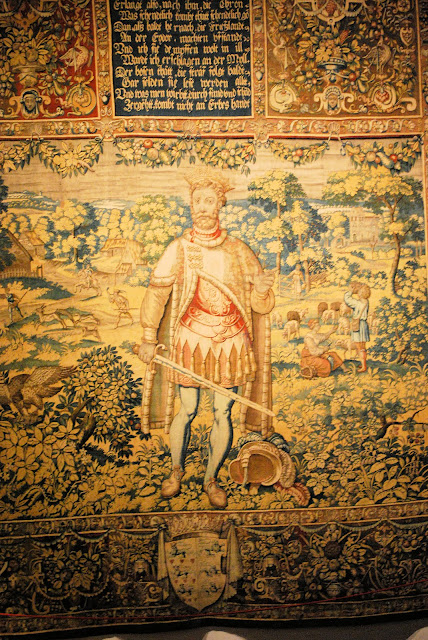
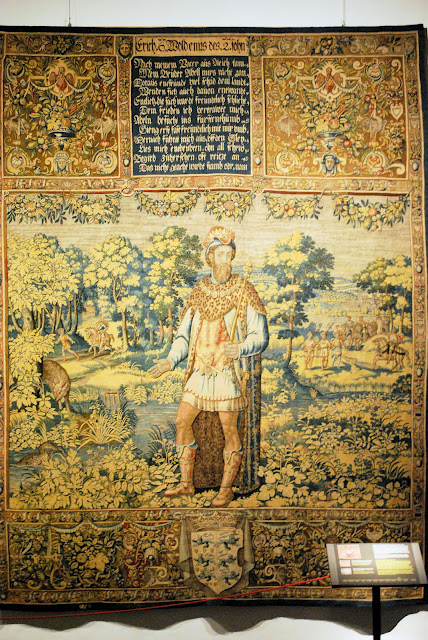
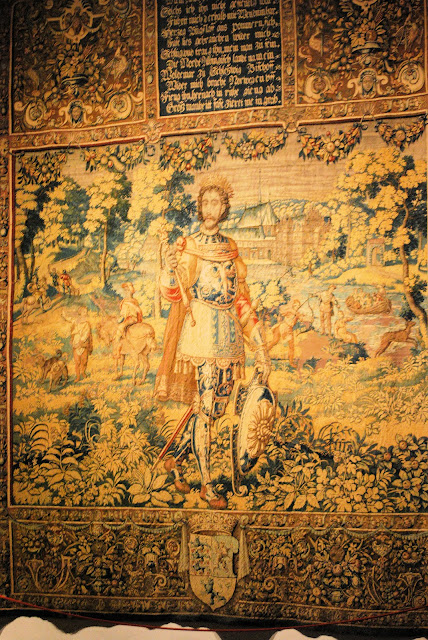
Finally, in the last tapestry of this series, we come to the one depicting Oluf (king 1376-1387):


Oluf was the son of the Norwegian King Haakon VI and Margrete, the daughter of the Danish King Valdemar III. Oluf’s mother Margrete was also depicted in the series, but the tapestry dedicated to this extraordinarily powerful woman in Nordic history no longer exists. As a guardian for the young Oluf, Margrete succeeded in gaining power in Denmark as well as Norway. In the verses at the top of the tapestry, however, it is nowhere acknowledged that Oluf was a king by name only, and not by deed!

As a matter of fact, Oluf died before he had become of age, and soon Margrete was confronted by King Albrecht of Sweden who laid claim on her two kingdoms. Yet King Albrecht’s confrontation led to complete failure: he was defeated and forced to surrender his own kingdom to Margrete, who triumphantly united her three kingdoms in the Union of Kalmar (1397-1523). Formally, the union was governed by her young relative Erik IX of Pomerania, whose tapestry is still preserved in the Danish National Museum in Copenhagen. In reality, however, it was Margrete who pulled the strings. [Margrete here is the same Queen Margrethe I who died in 1412, and whose lavishly carved sarcophagus we have seen in Roskilde Cathedral in our post of December 13, 2021, at http://blog.appletonstudios.com/2021/12/the-sarcophagus-of-medieval-queen.html]


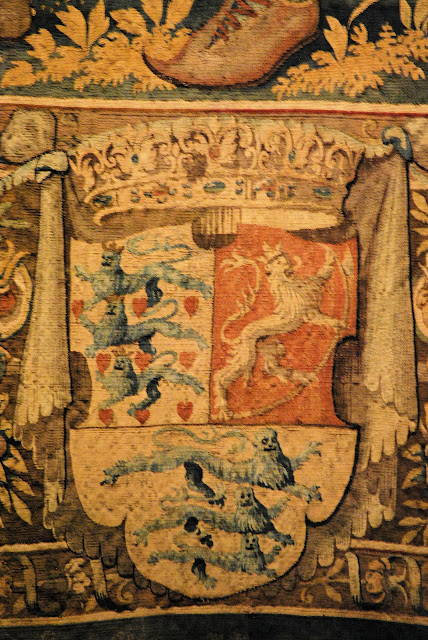
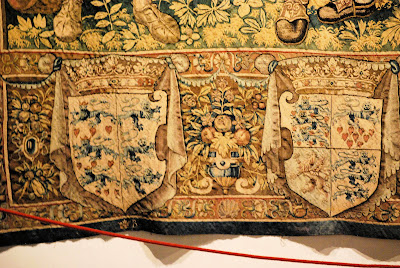
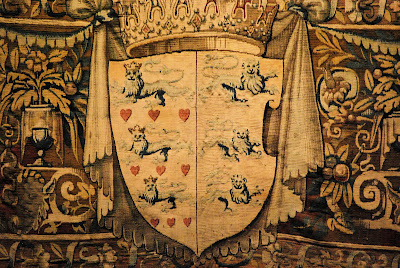
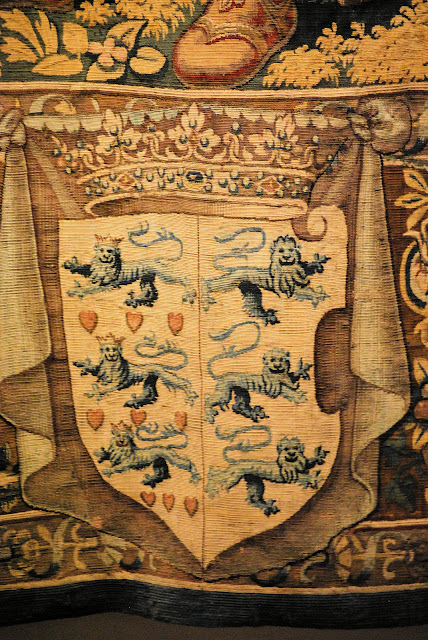
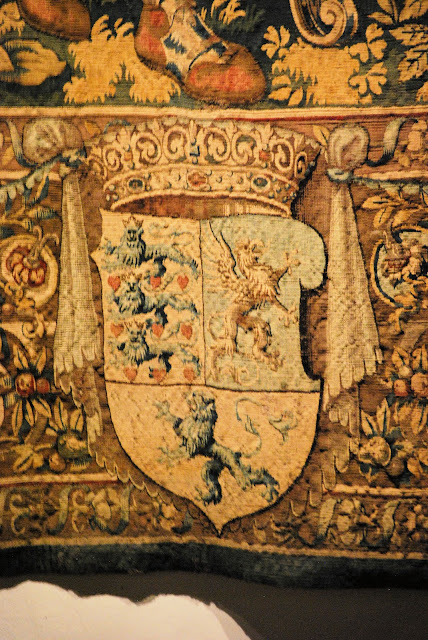
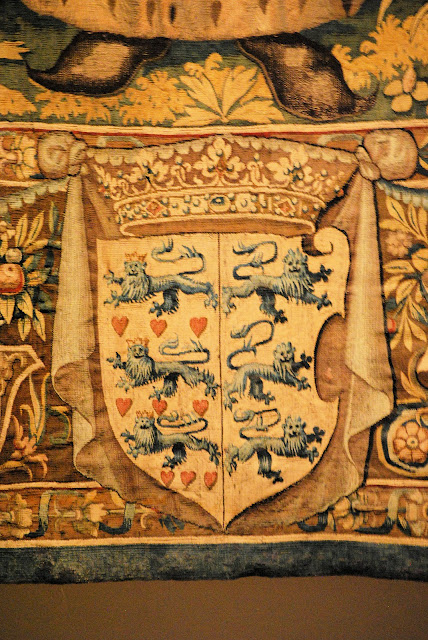
The king’s coat of arms carries the three lions of Denmark, the axe-bearing Norwegian lion, and the three “Baltic” lions. In reality, however, none of the Baltic regions were still governed by the Danish kings.

This post ends our trip to Kronborg Castle in Helsingør, and indeed to all of the heraldry that we have seen during our stay in Denmark. I hope that you have found at least some of these posts to have been of interest!

Monday, March 28, 2022

Armorial Tapestries at Kronborg Castle: King Christoffer II


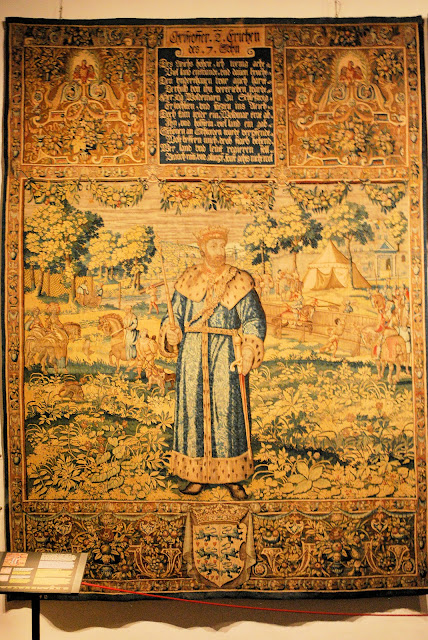
The next tapestry in this royal series is that depicting Christoffer II (king 1319-1332):


Accompanied by trumpeting horsemen, a knights’ tournament is held in the background to the right. To the left, a couple of workers are setting up enclosures prior to the noblemen’s hunt. Tournaments and hunts were privileged activities of the king and the nobility and as such, they are a much-favored motif in the tapestry series. In this particular instance, however, the jousting horsemen probably carry a second meaning, mockingly commenting precisely the king’s lack of jousting and warfare abilities.

The king’s inability is displayed in the accompanying monologue, which opens as follows: “for the kingdom’s dignity I little cared / much land gave away, with others shared / against my subjects I was also tough / so, from my throne they pushed me off”. Later Christoffer did in fact regain his throne, but this was accomplished only by buying foreign support and by pawning several territories. This approach entails the following conclusion: “He, who wants to rule people and land / needs advice and honor, or it all turns into sand.”


Only the three lions of Denmark and the three uncrowned “Baltic” lions are present in the king’s coat of arms. The armorial bearings that symbolize those territories, which his predecessor Erik VIII had conquered, have vanished once again.

Thursday, March 24, 2022

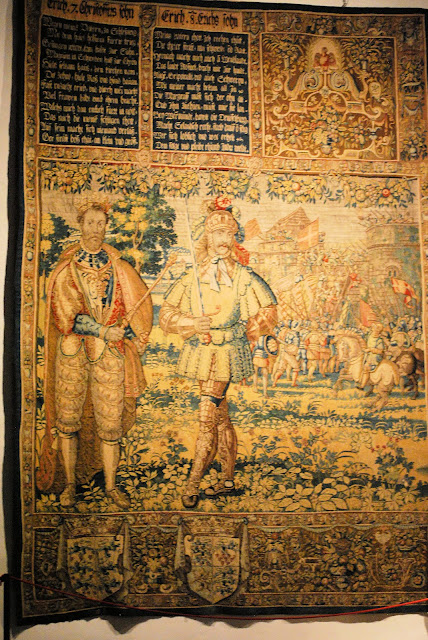
Armorial Tapestries at Kronborg Castle: Kings Erik VII and Erik VIII


Now we come to a tapestry not one king, but two: Erik VII (king 1259-1286) and Erik VIII (king 1286-1319)


The destiny of Erik VII is intertwined with perhaps one of the most well-known murders in Danish history: the regicide in the barn at Finnerup. The brutal fate of Erik VII is scarcely mentioned in the accompanying monologue, stating that “my own struck me down”. In the verses at the top of the tapestry, however, it is openly acknowledged that the king’s violent end to a large extent was self-inflicted – he was notorious for stealing the church taxes and for misusing his royal power to seduce the noblewomen of the realm.

Notwithstanding the king’s flawed character, the murder of a king should not be tolerated. Accordingly, the monologue of his successor, Erik VIII, acknowledges this king for having revenged his father. Furthermore, Erik VIII is famous for the conquest of several territories in northern Germany. Appropriately, a besieged town is seen in the background of the tapestry. The defence is breached by spear-bearing infantry, who ascend the town walls using ladders. On top of the wall the red and white flag signify that the Danish king’s arms is about to win yet another battle.

Mounted on his rearing horse, the king calls out for combat and brandishes his marshal’s baton, the commander-in-chief’s mark of distinction.


Erik VIII’s great success on the battlefield is accounted for in the king’s coat of arms, where yet a couple of armorial bearings are displayed in comparison with his predecessor’s coat of arms. The griffin at the bottom left symbolizes the land of the Wends, and the lion and hearts at the upper right symbolizes the land of the Goths, or Jutland.

Monday, March 14, 2022

Armorial Tapestries in Kronborg Castle: King Abel


Next we come to the tapestry depicting the short reign of Abel (king 1250-1252):


A quiet peasant scene and a group of hunters on foot or mounted on horses is seen in the background of the tapestry. This apparently idyllic setting sharply contrasts the ferocious acts spelled out in the accompanying verses: “For kingship I did crave / thus my brother I sent to the grave”. Consequently, the wildlife of the foreground carries a hidden symbolism, referring to Abel’s dreadful deed.

On the left side of the king, a falcon has put its claws on a small bird while a poisonous snake is quietly slipping away in the shrubbery underneath. Most likely, this scene is modelled on the classical theme of the “Eagle fighting the snake”, symbolizing the struggle between good and evil. Alas, in this instance evil – in the shape of the snake – slips away while the claws of the falcon grip the powerless bird. Due to higher justice, however, the evil king was himself killed in an uprising only two years after the ruthless assassination. The overturned helmet at his feet refers to his death on the battlefield.


Abel carries the same armorial bearings as his predecessor, the brother he had assassinated: the three lions of Denmark and the uncrowned “Baltic” lions. During his short reign no further territories were conquered.

Thursday, March 10, 2022

Armorial Tapestries in Kronborg Castle: King Erik VI


Next we come to the tapestry depicting Erik VI (king 1241-1250):


The king wears a crown on top of his hat and is dressed in a costume with no authentic historical reference – supposedly signifying that the king ruled “in distant times” (well, distant from the times of Frederik II, who commissioned these tapestries and ruled from 1559 to 1588). In his left hand he clutches his scepter while vividly gesticulating with his right hand. This significant gesture draws the viewer’s attention towards the animal life in the foreground on the king’s left side. A wolf lurks in the bushes, attentively watching a bittern which has caught an eel. The wolf, the incarnation of evil, sneaks up on its unsuspecting prey, while the bird grasping the slippery eel, the symbol of falsehood, quite possibly signifies that good shall overcome evil in the end.

Consequently, the wildlife of the foreground contains a hidden reference to the king’s ill-fated destiny. As a matter of fact, Erik was assassinated by his own brother, Abel, who much envied his crown. Abel, who is depicted on the next tapestry in line, did not live to regret his brother's murder, however, as he was killed on the battlefield only two years later.


The king’s coat of arms carries the three lions of Denmark and three uncrowned lions that symbolize the Baltic territories of the Danish kings.

Monday, March 7, 2022

Armorial Tapestries in Kronborg Castle: King Valdemar II


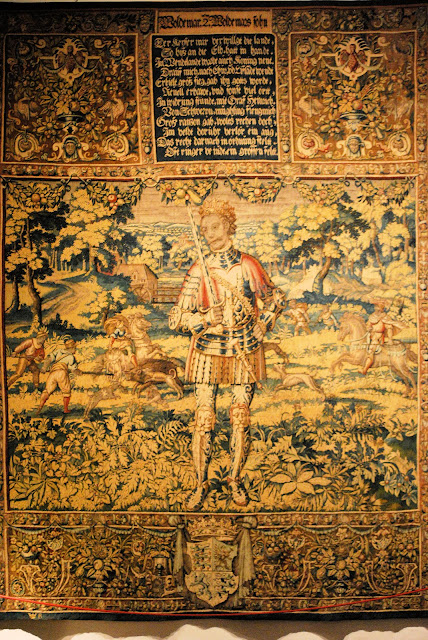
The next tapestry in order of his reign is that depicting Valdemar II “the Victorious” (king 1202-1241):


Clad in his shining armor, the king carries his crown, the most powerful symbol of royalty, and he brandishes his sword as if preparing for combat. In the accompanying German verses, a full account is given of the king’s many successful war campaigns which secured him the epithet “The Victorious”. The king’s many victorious battles, however, are nowhere accounted for in the background of the tapestry, where a hunting scene occupies the entire scenery.

As stated in the verses at the top of the tapestry, Valdemar II was also an accomplished legislator. In the final years of his reign, the first official code of the kingdom, Jyske Lov (the law of the province of Jutland), was written down. In fact, the oldest surviving transcript of this code is presently to be found in Sweden, to where it was taken as a spoil of war during the years of the Swedish occupation of Denmark (1658-60). On the same occasion, most of Kronborg’s priceless art treasures were also shipped to Sweden – including the table canopy of Frederik II that belonged to the series of king tapestries.


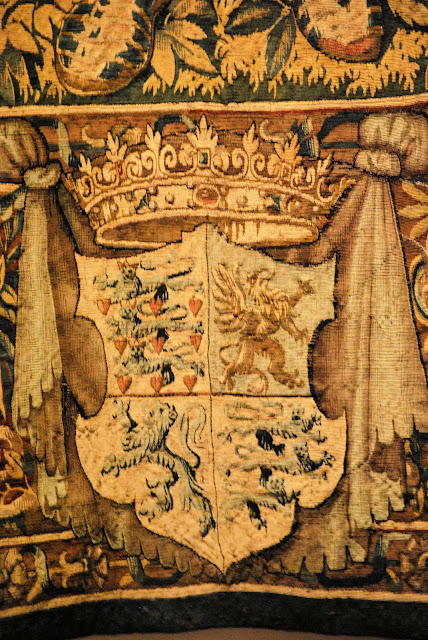
Compared to the coat of arms of Knud VI, yet another armorial bearing is here introduced: three uncrowned lions – a symbol of the Baltic territories that were conquered by Valdemar II, and which we'll be seeing more of in this series of armorial tapestries.

Thursday, March 3, 2022

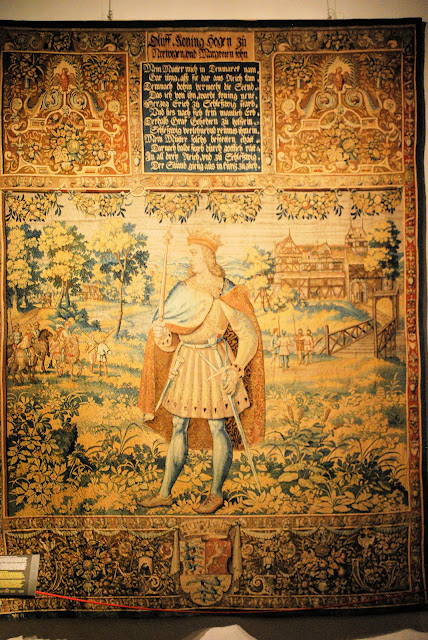
Armorial Tapestries in Kronborg Castle: King Knud VI


Upstairs in Kronborg Castle there is on display a series of tapestries commissioned by King Frederik II (reigned 1599-1598), who did so much to modernize and extend the Castle, depicting some of his predecessors. Each tapestry contains a block of text relating to the king portrayed.

I am going to review these tapestries in chronological order of their reigns as kings of Denmark. Much of the information given with each tapestry comes from the informational signs, in Danish and in English, accompanying each tapestry.

First is the tapestry depicting Knud VI (king 1182-1202):


The king wears richly ornamented body armor and is armed with sword and shield. Furthermore, the king’s dignity is emphasized by the royal regalia: crown and scepter. His breastplate depicts the imperial eagle, referring to the king’s opposition to the German emperor, Frederik Barbarossa, who is mentioned in the accompanying verses. The Danish king was met with a demand to plead allegiance to the emperor, but this he ardently refused. On the contrary, he led his army into northern Germany, where he conquered several territories which were under the jurisdiction of the emperor.

In reality, the powerful Bishop Absalon played a major part in the Danish king’s victories. However, following the Lutheran reformation of the Danish church in 1536, the bishops of the realm had been stripped of their former political power. Frederik II, who was an orthodox Lutheran, probably felt not urge to have the political power of the late bishop Absalon spelled out in his tapestry series!

A large convent is seen behind the king: the now-demolished Groenendael south of Brussels. The motif is purely decorative and is derived from a tapestry designed by Berent van Orley.


Apart from the three lions and nine hearts of Denmark, two further armorial bearings are displayed in the king’s coat of arms. The griffin refers to the land of the Wends, the standing lion to Northalbing, i.e., the land north of the river Elbe.

Monday, February 28, 2022

Territorial Coats of Arms in the Chapel at Kronborg Castle


Having already seen the lesser arms of Denmark surrounded by the arms of its territories, found in the Chapel at Kronborg Castle, as part of our post from a week ago, on February 21, today we're going to look at some of those same territorial arms as found on the ends of pews in the Chapel.

A sign there in Danish and in English gives us some helpful information about the history of the Chapel:

Kronborg Chapel

In 1577, the building of the Chapel was commenced by Frederik II, and the grandiose inauguration took place in 1582. However, the many-colored wood carvings that lend a special Renaissance luster to the room were still under completion in the following years.

The castle fire of 1629 left the Chapel virtually untouched. As Kronborg was handed over to the military in the 18th Century, however, the furniture was removed. The space was needed for fencing, gymnastic exercises, and ammunition storage. In 1840-43, the Chapel was restored and the original furniture returned.

The "original furniture" restored to the Chapel include territorial arms include the pews, each of which has on its end carved and painted coats of arms, supporters, and a profusion of other decorative elements, perfectly matching the style of the display of the lesser arms of Denmark we saw last week.

In some instances, I have included a photo of more of the pew end to give you a better idea of the overall context, as well as close-ups of the arms themselves. Taken as a whole, it's quite an impressive display of heraldry!

(Many of the territorial arms seen here can be identified as being the same as those found in the Rose Room of Frederiksborg Castle, in my post of July 12, 2021, at http://blog.appletonstudios.com/2021/07/the-heraldry-in-rose-room-part-1-kings.html)


Thursday, February 24, 2022

The Greater Arms of Denmark in Kronborg Castle


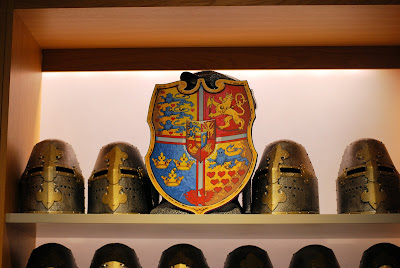
Not surprisingly, after finding several depictions of the lesser arms of Denmark at Kronborg Castle in Helsingør, I also found the greater arms of Denmark there.
Surprisingly, they were found in the gift shop!


And here they are, available for purchase, on a small shield, on display and surrounded by great helms.

We have seen this particular version of the greater arms of Denmark before. See, for example, my post of July 19, 2021, from Frederiksborg Castle, at http://blog.appletonstudios.com/2021/07/these-doors-are-my-doors-that-door-is.html
I have to admit, I was somewhat tempted to purchase this shield, but I wasn't sure how well it would survive the trip back home jammed into my suitcase, and besides, we were already spending a fair bit of money in the gift shop on Hamlet-related items, like the throw pillow cover of a skull wearing a crown (made in France!) and a fabric Christmas tree ornament of Hamlet holding a skull in one of his hands. ("Alas, poor Yorick!")

Plus, I'm not sure where I would have hung it here in the house even if it had survived the trip home. I mean, there's only so much room on the walls for heraldry, and they're all pretty well covered with arms as it is.
Still, it was tempting, though I managed to manfully resist it.

Monday, February 21, 2022

The Smaller Arms of Denmark at Kronborg Castle


Continuing our armorial look at Kronborg Castle in Helsingør, Denmark, we were not especially surprised to find depictions of the arms of Denmark, given that Kronborg was a royal castle.

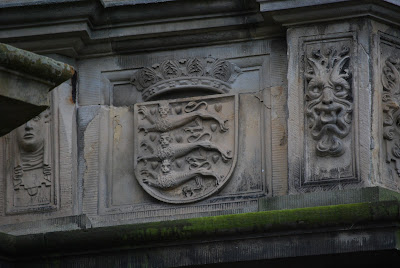
Today, we're going to look at the depictions we found of the lesser, or smaller (that is to say, the plain, unquartered), arms of the kingdom.

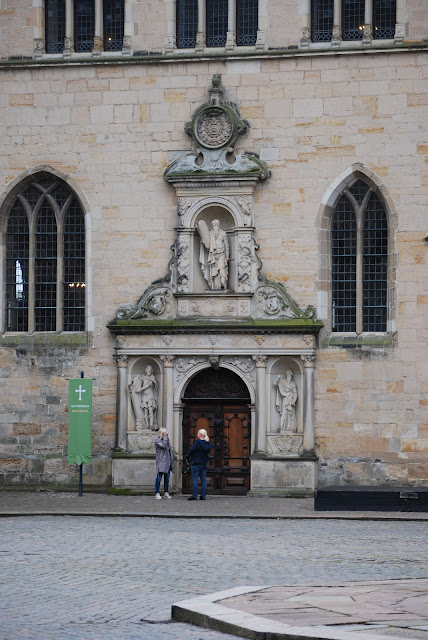
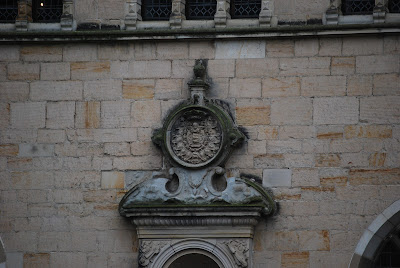
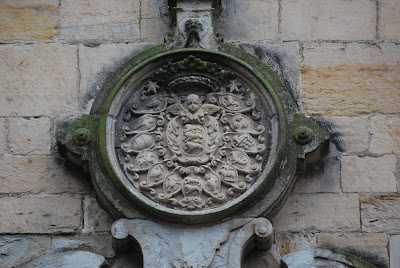
Here on a stone frieze we find the three lions and nine hearts of Denmark on a crowned shield.


Next, we came to this very impressive doorway in the inner courtyard surmounted by the arms of Denmark surrounded by thirteen shields of the arms of its claimed territories.


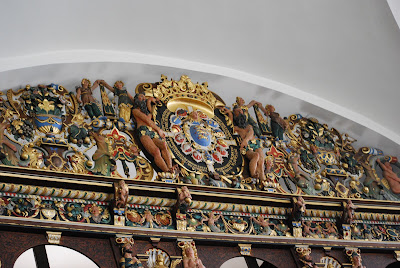
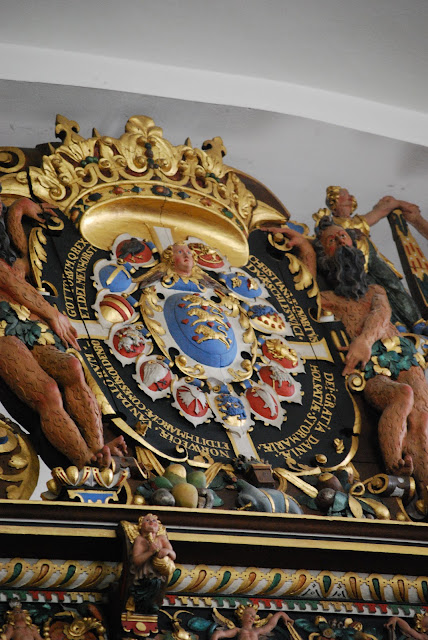
Inside, in the Chapel at the castle, we find this same motif, the arms of Denmark surrounded by arms of its territories, only this time gloriously carved in all of its Baroque splendor and painted in full color.


We’ve seen this armorial layout before, at Frederiksborg Castle. For example, in my post of June 24, 2021, at http://blog.appletonstudios.com/2021/06/royal-heraldry-at-frederiksborg-castle.html

Many of the territorial arms surrounding the lesser arms of Denmark can be identified from those found individually in the ceiling of the Rose Room in Frederiksborg Castle, in my post of July 12, 2021, at http://blog.appletonstudios.com/2021/07/the-heraldry-in-rose-room-part-1-kings.html

Thursday, February 17, 2022

Royal Ciphers on Kronborg Castle


Looking for heraldry and heraldry-like items at Kronborg Castle in Denmark, we found a number of royal ciphers. In this post, we're going to visit them in chronological order by reign:

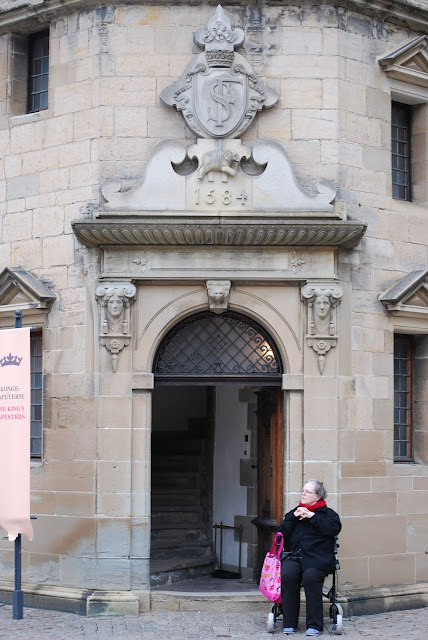
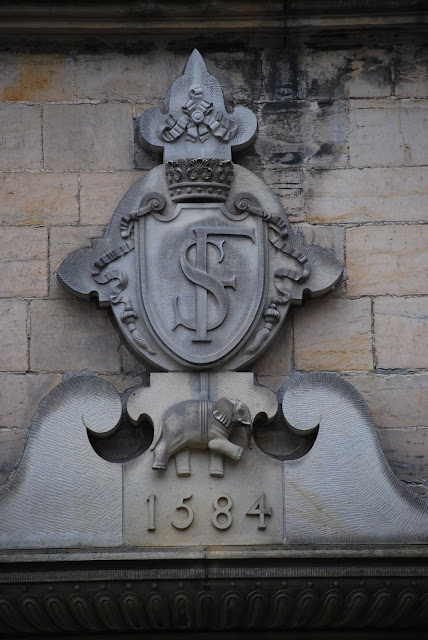
King Frederik II (reigned 1559-1588) was the man who had the medieval fortress radically transformed into a magnificent Renaissance castle. His cipher can be seen over a couple of different doorways in the Castle courtyard, here:


And again, here (with my ever-patient wife waiting for me to finish taking pictures so we can both go and see more of the castle):


A more detailed view of the above, where you can see the crown over the shield and the elephant emblem of the Order of the Elephant more clearly:


King Christian IV (reigned 1588-1648) had it rebuilt following the fire in 1629 which destroyed much of the castle.

Here we see his cipher inside the castle, crowned and encircled by the arms of the Danish territories:


King Christian V (reigned 1670-1699). The Swedish conquest of Kronborg in 1658 demonstrated that the castle was not impregnable. Under Christian V, from 1688 to 1690, an advanced line of defense was added called the Crownwork. Shortly after that, a new series of ramparts were built around it. At their completion, Kronborg was considered the strongest fortress in Europe.


King Frederik IV (reigned 1699-1730) over a gatehouse. (You may wish to click on the image below to see a larger version where many of the details of this display can be seen more clearly.)


From 1739 until the 1900s, Kronborg was used as a prison. The inmates were guarded by the soldiers billeted in the castle.

As Kronborg's importance as a royal castle diminished, the armed forces came to play a greater role. From 1785 to 1922, the castle was completely under military administration. During this period, a number of renovations were completed.

I believe this is the cipher of King Frederik VI (reigned 1808-1839) (again, you can click on the image below to see a larger, more detailed photo), but the cipher on the sinister (right-hand, as you look at it) side of the shield, A S or S A, do not match the initials of his wife, Marie of Hesse-Kassel. 


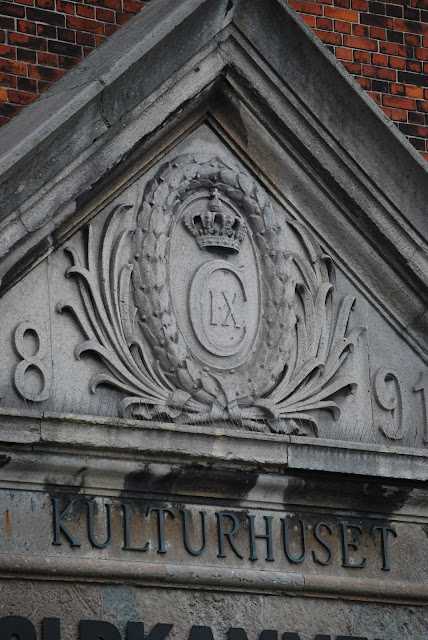
And finally, the cipher of King Christian IX (reigned 1863-1906).


Monday, February 14, 2022

Today: History; Next Time: Heraldry


And now we come to the primary goal of our trip to Helsingør, Denmark: Kronborg Castle.

But instead of just jumping right in and looking at the heraldry that is there, I thought it might be good to discuss some of the history of the castle and why it is so worthy of a visit.

Situated on the coast of Denmark and adjacent to the town of Helsingør, Kronborg Castle is a fairly classic "star fort", so-called because their defenses when seen from above are reminiscent of a star.

Here's a picture of a model of the castle to give you a better idea of what I mean.


The site of Kronborg Castle was originally a stronghold, Krogen, built by King Eric VII in the 1420s. Along with the fortress Kärnan in Helsingborg on the opposite coast of Øresund, the sound between present Denmark and the provinces of present Sweden, 2.5 miles wide at this point, it controlled the entrance to the Baltic Sea. After the conclusion of the Northern Seven Years' War in 1570, King Frederick II initiated an extension of the advanced bastions to relieve the medieval curtain wall. And from 1574 to 1585, King Frederick II had the medieval fortress radically transformed into a magnificent Renaissance castle.

Frederick was a keen patron of theater and players performed at the castle when he held court there in 1579. (Remember this point; it’s relevant later.)

James VI of Scotland (later also King James I of England) stayed in the castle in 1590 after his marriage to Anne of Denmark.

In 1629, a fire destroyed much of the castle, but King Christian IV had it rebuilt. In 1658, Kronborg was besieged and captured by the Swedes who took many of its valuable art treasures as war booty. In 1785 the castle ceased to be a royal residence and was converted into barracks for the Army. The Army left the castle in 1923, and after a thorough renovation it was opened to the public (that is, people like you and me!).

Kronborg is known to many as "Elsinore", the setting of William Shakespeare's famous tragedy Hamlet, Prince of Denmark, though "Elsinore" is actually the anglicized name of the surrounding town of Helsingør. It is widely believed that the celebratory party held by King Claudius in Hamlet is based on the celebrations and plays performed at the castle for King Frederik II in 1579.

Hamlet was performed in the castle for the first time to mark the 200th anniversary of the death of William Shakespeare, with a cast consisting of soldiers from the castle garrison. The stage was in the telegraph tower in the southwest corner of the castle.

The play has been performed fairly regularly in recent years in the courtyard and at various locations on the fortifications. In one of the rooms of the castle, they display photographs of some of the famous actors who have played in live productions of Hamlet at the Castle.

How many of these actors do you recognize? A few, like Fu Xiru, were completely new to me. But many of the others (e.g., Derek Jacobi, Michael Caine, Richard Burton, Kenneth Branagh, Laurence Olivier, and even Jude Law) felt like old friends.

Be sure to notice the various parts of the Castle in the backgrounds of all of these photos.


In addition, it is still possible to find 1964's Hamlet at Elsinore, a production of the play starring Christopher Plummer in the title role and filmed at Kronborg Castle.

Anyway, that's your introduction to Kronborg Castle. Next time, we'll look at some of the royal ciphers and heraldry that appear there.