Thursday, November 12, 2020

The Many Uses of the Arms of the City of Ghent


Not surprisingly, as you wander about the old city of Ghent, Belgium, you can see it's coat of arms used so frequently that you believe it must be everywhere. It isn't, not really, but it does feel a bit like that.

The arms of the city are Sable a lion rampant argent crowned or, sometimes shown with a gold collar around its neck from which hangs a cross, also gold.

And here are some wonderful examples of how the city uses it heraldry.

On traffic-controlling pylons:


And, of course, on street signs:


In different places on the Belfort, one of the three medieval towers that overlook the city:


On some of the shutters on the Belfort:


Marking a spot in a pedestrian walkway:


Or commemorating "Governance of Benevolence" in 1908. The Latin motto translates to "Faith and Love".


Carved on the façade of a building:


And as a free-standing flag supported by a crowned lion as on the shield:


So there you have it! A selection of the arms of the city of Ghent, in different media, with uses from the purely decorative to the practical, large and small.

How cool is all that?

Monday, November 9, 2020

Is It Heraldry? Or Is It a Political Statement?


Moving past the heraldry, and non-heraldry, on the façade of the Institut Laurent, we found ourselves being led down an alleyway which was covered with all kinds of graffitied artwork. It is named Werregarenstratt, but everyone just calls it Grafittistraatje. The city has designated this walkable alley as a space where graffiti paining is not only allowed, but encouraged! It is very colorful, and some of the artwork shows a lot of skill and imagination.

Nonetheless, one of the pieces that caught my eye was not very large, but because it was "on" a shield, it attracted my attention. (See my post of November 2, 2020 for a more complete description of how this works on me.)


See? Shield, surmounted by a coronet. Instantly attractive to all but the most jaded heraldist. But what's happening on, and even more off, the shield?


The critter on the shield looks more like a ram statant to me than it does an heraldic bonacon,* but what's the deal with the, umm, "ejecta" flying off the shield to sinister?

Is it heraldry? Or is it a political statement, one that I, as a foreigner there, don't quite catch?

In some ways, it really doesn't matter. It is a statement, artistic or political or whatever, that uses heraldic imagery to make it's point. Thus demonstrating that heraldry, in one form or another, is still alive and kicking here in the 21st Century.


* As we learn in Monsters Of Heraldry by Donald R. Barnes: "The BONACON has a body and head like a bull, but with a horse's mane. It curled horns are useless for attacking, so (as it retreats) it releases the contents of its large intestine, and this fiery excretion covers 3 acres (that's 1.2 hectares if you want it in metric) and burns to a crisp anything or anyone in that area." Not something you'd want to stand behind, then.

Thursday, November 5, 2020

Heraldry and Not-Heraldry in Ghent


As we walked away from the Friday Market Square towards our next destination in Ghent, Belgium, we passed by the building of the Institut Laurent, housing the Basisschool François Laurentinstitut elementary school at 10 Ondeerstraat.

The front of the school has a large coat of arms flanked by the name of the institute.


Here's a better "face on" view of the name and coat of arms on the facade.


The coat of arms is, of course, the arms of the city of Ghent (Sable a lion rampant argent crowned or) surmounted with an embattled or "mural" coronet.


There are also a number of decorative figures of children sitting at desks with open books and cartouches with symbols of some of what they are learning at the Institute.

Here we have two children, one writing and one reading, with putti on each end holding up scrolls with the words Orde (Order) and Tucht (Discipline) on them.


The somewhat Baroque cartouches, though not truly heraldry, display some of the subjects taught at the Institute which the students are learning:

Reading and writing, symbolized by the book and quill pen, with laurel branches encircling the central motif,


and Geography, symbolized by the globe, with palm leaves:


All in all, an interesting display of carved heraldry and non-heraldry.

Monday, November 2, 2020

Squirrel!


Whenever I'm walking the streets of a new town - like, for instance, Ghent, Belgium - I feel like my head is on a swivel. I mean, I can usually be seen walking along, camera in hand, looking this way and that for potential heraldry.

Unless, of course, I find a coat of arms, and then I'm pretty much focused on it until I've taken a good look and sufficient photographs, and then I start "swivel-necking" again until, like my little 15 pound terrier, I see another "Squirrel!"

In this specific instance, we were still congregated in the Friday Market Square (Vrijdagmarkt) in Ghent, and I had finished walking completely around the statue of Jacob van Artevelde and taking plenty of pictures (more than I have shared with you in the previous three posts), when I spotted a coat of arms on the side of a truck that was parked and peeking out from behind a van at the edge of the square.

Squirrel!


The arms are, of course, and as it is written on the side of the truck, those of John I of Brabant (also called John the Victorious) (1252/53 – 3 May 1294), Duke of Brabant (1267–1294), and Duke of Lothier and Limburg (1288–1294).

His arms as painted here are blazoned: Quarterly: 1 and 4, Argent a lion rampant gules (Limburg); 2 and 3, Sable a lion rampant or (Brabant). More often, you will see his arms with the quarters reversed from the order here, with Brabant in the first and fourth quarters (upper left and lower right), and Limburg in the second and third (upper right and lower left). That said, the Codex Manesse or Great Heidelberg Book of Songs, Cod. Pal. germ. 848, 18r (https://digi.ub.uni-heidelberg.de/diglit/cpg848/0031), shows his arms as here on the truck. So who am I to say that one is "correct" and the other is "incorrect"?

Thursday, October 29, 2020

Guild Arms on the Jacob van Artevelde Monument in Ghent


Completely encircling (and I do mean literally all the way around) the plinth of the Jacob van Artevelde monument in Vrijdagmarkt Square in the city of Ghent, Belgium, is a plethora of shields of the arms of the various guilds (I recommend clicking on the images here to see a larger, more detailed copy). To wit (and walking clockwise around the monument):


And, of course, I took separate pictures of the shields, one large and three smaller above it, on each of the squared-off "corners" of the plinth:


Many of the guild arms are identifiable simply from their display of the tools of the trade they represent, e.g., the shuttles for the weavers, the wheel and tools of the wheelwrights, the leatherworkers, the masons, the pewterers, etc.

Others are not so clear-cut (e.g., is the dolphin the fishmongers or the fishermen, or something else?). For another example, the large shield immediately below (Gules a cross of Jerusalem or) is the arms of the St-Joris Kruisboog, or St. George Crossbow guild.


And if you stand back a bit and take in the entire monument, it is an impressive display of heraldry!


Don't you agree?

Monday, October 26, 2020

Civic Heraldry on the Jacob van Artevelde Monument in Ghent


 Below the statue of Jacob van Artevelde in Vrijdagmarkt ("Friday Market") Square in the old city of Gent/Ghent, it is just chock-a-block full of coats of arms.

Most notable among these, however, each held by a woman, are the arms of Flanders, Bruges, Ypres, and Ghent.

Here, from one side of the monument, are Flanders (left), Or a lion rampant sable, and Bruges (right), Barry argent and gules a lion rampant azure.


On the other side of the monument, we find Ypres (left), Gules a cross vair on a chief argent a patriarchal cross gules, and Ghent (right), Sable a lion rampant argent crowned or.


Between these last two is a panel of the three women representing Bruges, Ypres, and Ghent with the 1338 treaty forming a federation of the three cities. You can see the arms of Ypres above center, with the arms of Bruges on the left and Ghent on the right behind the ladies' heads..


What a great display of heraldry!

Thursday, October 22, 2020

A Day-Long, Long-Day Excursion to Ghent


So, having (finally!) finished our heraldic tour of Antwerp, the Congress we were attending there had, for those who so desired, a day-long excursion to the nearby city of Gent/Ghent.

Yes, the same city in the title of the Robert Browning poem, "How they brought the good news from Ghent to Aix." Never mind that in the poem, you never find out what the good news is; it's really much more about the horse Roland. But, yes, that Ghent.

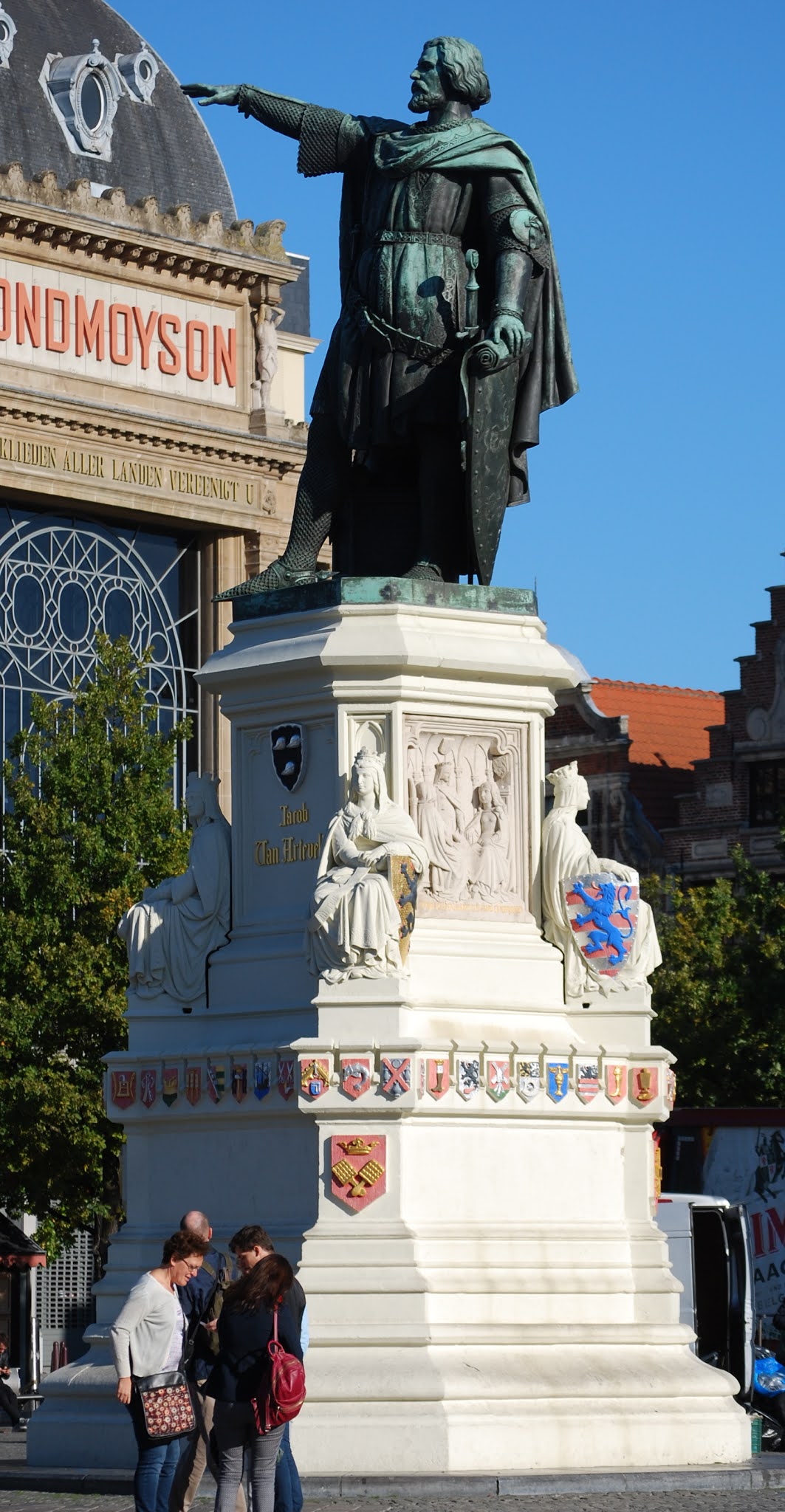
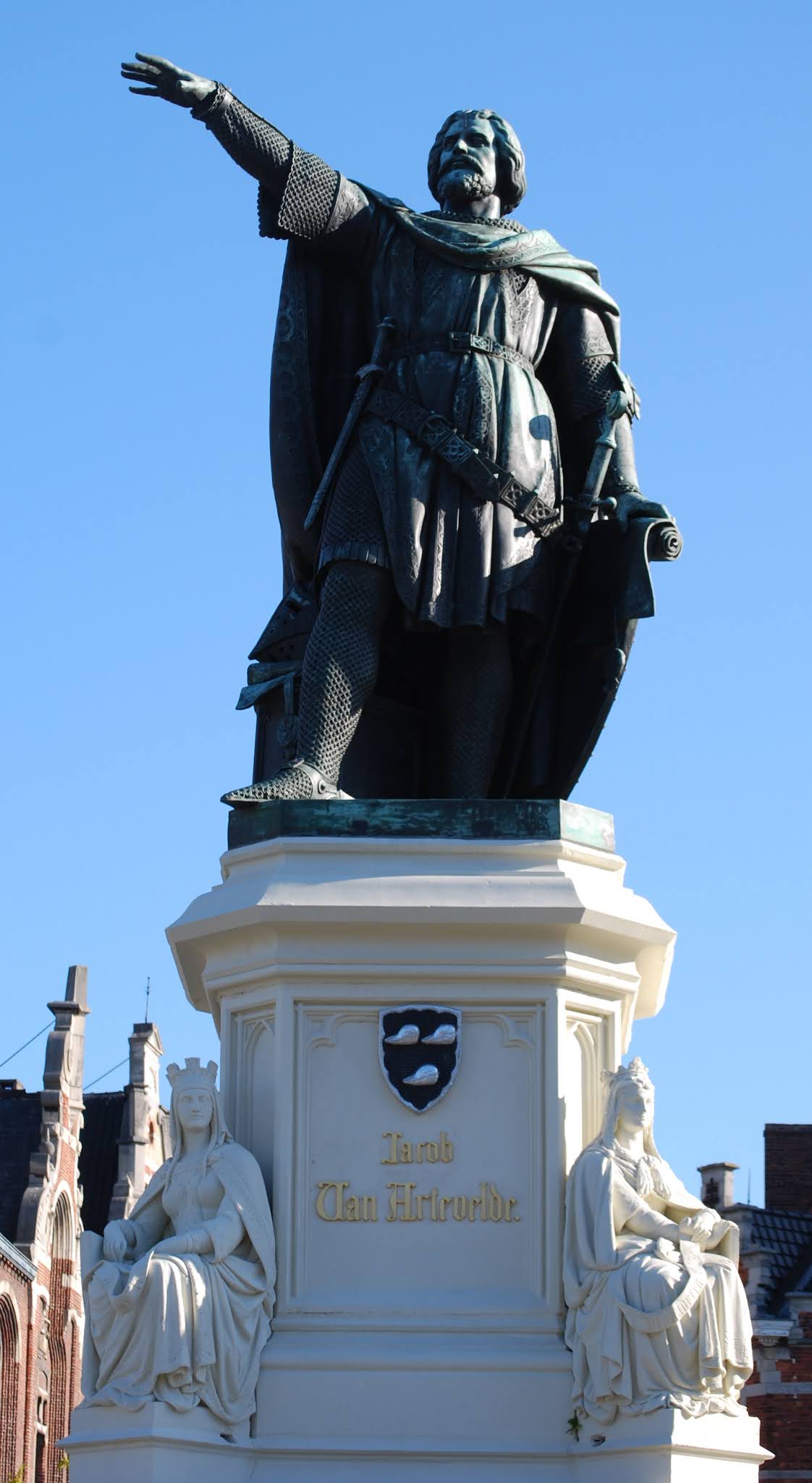
Anyway, we got off the bus near the large Vrijdagmarkt square, where about the first thing we noticed was the large monument and statue of Jacob van Artevelde.


(Every time I see a statue like this, with one hand pointing somewhere, I cannot but think that he is saying: "You left your car over there!")

Anyway, in case you haven't heard of him before, here's a bit of history of the man:

Jacob van Artevelde, also known as The Wise Man and the Brewer of Ghent, was a Flemish statesman and political leader. He was born in Ghent to a wealthy commercial family. He married twice and amassed a fortune in the weaving industry. He rose to prominence during the early stages of the Hundred Years' War. Fearful that hostilities between France and England would hurt the prosperity of Ghent, he entered political life in 1337. He set up an alliance with Bruges and Ypres (later the Four Members) in order to show neutrality. Van Artevelde gained control of the insurrection against Louis I, the Count of Flanders who had abandoned his father's anti-French policies. Louis I was forced to flee to France, while van Artevelde served as captain general of Ghent from that time until his death. 

The Count of Flanders tried to overthrow van Artevelde’s power by force of arms but failed completely and was compelled at Bruges to sign a treaty (June 21, 1338) sanctioning the federation of Ghent, Bruges, and Ypres (hence the arms of those three cities, with Flanders, on the monument). Flemish relations with England had traditionally been good, due to wool and textile trade. Neutrality was eventually broken, and the towns took the side of the English in 1340. In that year, van Artevelde persuaded the federation to recognize King Edward III of England as sovereign of France and overlord of Flanders. Flemish trade and industry flourished under van Artevelde's semi-dictatorial rule. In 1345, however, rumors that he planned to recognize the son of Edward III, the Black Prince, as count of Flanders, suspicion of embezzlement, and the excommunication by the Pope caused a popular uprising in Ghent and van Artevelde was killed by an angry mob.


On the front of the monument is plaque with his name in raised letters and a coat of arms, presumably his: Sable three hats or caps within a bordure engrailed argent. (Riestap's Armorial Général blazons them as couronnes de feuillage, or "crowns of foliage". But these are definitely hats.)

UPDATE: This particular type of hat or cap is called bycocket or bycoket, is a style of hat that was fashionable for both men and women in Western Europe from the 13th to the 16th century. It has a wide brim that is turned up in the back and pointed in the front like a bird's beak. In French, it is called a chapeau à bec due to this resemblance.

Anyway, here's a couple more views of the statue from different angles for your viewing pleasure. (On the whole, I am impressed by the sculptor's creating of the chain mail on the statue.)


As you may note, the shield on which he rests his hand is not the van Artevelde arms. Here's a closer view:


As you can see, it is quite clearly a lion rampant. I suspect, without being certain (shields with a single rampant lion are a virtual plague in this part of the world; without tinctures, it is very difficult to be sure what entity a shield with a single lion on it represents), that it is supposed to be the arms of the city of Ghent: Sable a lion rampant argent crowned or. (We will be seeing a lot more of the city's coat of arms, trust me!) It also appears to have a bordure engrailed added to it; I don't know why.

Next time, we'll start looking at all of the other heraldry on this monument.

Monday, October 19, 2020

Two Displays of Heraldry


In this, the final post of my heraldic excursions in and about Antwerp, Belgium, we come to two very nice displays of heraldry.

Participants in the Congress were invited to a reception at the City Archives one evening, and while there we were treated to a number of heraldry-related items from those Archives.

It didn't hurt that two of those items consisted of some of the more complex, and colorful, uses of heraldry: heraldic family trees, here, specifically, descent trees.

I apologize for the quality of the pictures. I only had my phone with me to take photographs, and, naturally, the scrolls on which these trees were painted were behind glass, so there are lots of reflections.

First, we have the descent tree of the Doncker* family:


(I recommend clicking on the image above, or those below, to see a larger, more detailed version, so you can get all of the detail contained in these pictures.)

At the top left of the scroll we find this display of marital arms, those of Gisbertas Doncker and Maria Ryns:


The other descent tree, this one taller than it is wide, was that of the de Hobocken** family, starting with Nicolas de Hobocken at the top:


What follows are two closer shots of the tree:


There is a wonderful amount of detail in this descent tree: names, names of spouses and second spouses, and dates (1306 through 1433 in the visible portion of the scroll).

All in all, it was a fun evening with good friends and, of course, an abundance of heraldry to see!


* I have not been able to confirm elsewhere that these are the Doncker arms. The Donckers in Rietstap's Armorial Général bear different arms from these. This coat appears to be the quarterly arms ascribed to the van Pruyssen family in the Wapenboek van de Belgische Adel.

** What is now Hoboken, New Jersey in the United States, was originally called Hoebuck, old Dutch for high bluff and likely referring to Castle Point (the district of the city highest above sea level). Hoebuck was used during the colonial era, and later spelled as Hobuck, Hobock, Hobuk and Hoboocken. In the nineteenth century, the name was changed to Hoboken, influenced by Flemish Dutch immigrants and a folk etymology that had emerged linking the town of Hoboken to the similarly-named Hoboken district of Antwerp.

Thursday, October 15, 2020

Arms on the House of the Archers


Along one side of the main square in old Antwerp is a row of several ornately decorated guild houses.

One of these is the Huis van de Schutters, the home of the Sint-Joris Guild of Archers. This is a different guild from two whose arms we have already seen: the Old Longbowmen and Young Longbowmen Guilds. These Archers, or Shooters, used arbalests, or crossbows.


The "House of the Shooters", topped by a gilded statue of their namesake St. George slaying the dragon (which itself appears to be climbing up the facade of the building), has two roundels with a crossbow on each side of one level, while at the top of the next level there are relief carvings of two crossbowmen. (You can click on the image above to go to a larger picture where you can see these details more clearly.)

On the top level, below the statue of St. George, is an unusual coat of arms.


In an upside down shield surmounted by three towers (rather like a mural coronet), above an image of St. George and the dragon, flanked by the words Rust Rœst, is a landscape of a ship on the River Scheldt with the skyline of the City of Antwerp behind it. (Rather like this recent photograph, only without the sailing ship in the foreground. Again, click in the image above to see the skyline on the shield in more detail to better compare it to the modern skyline in the photo below. It appears not to have changed all that much in the last few centuries.)


I found it to be an interesting display of heraldry, on a building clearly meant to demonstrate the pride and prowess of the guild members.

Monday, October 12, 2020

Inside and Outside the Cathedral in Antwerp, Part 3 of 3


One final coat of arms of which I found examples both inside and outside of the Cathedral of Our Lady in Antwerp, Belgium, were the arms of the Bakers Guild


It's a great, simple, and immediately identifiable as belonging to bakers a coat of arms as you could hope to find.

It would be blazoned Azure two baker's peels in saltire between in pale two loaves of bread and in fess two (round loaves, or are they pies?) all or.

Now, that example was, obviously, found out on the street, on the wall of a building.

This example was hidden away in one of the many stained glass windows in the Cathedral.


You may have to hunt a bit to find it here, but the arms of the Bakers are in the top row of arms on the far right, impaling a coat of arms that is Gules a windmill vanes in saltire or with steps argent leading to its doorway sable.

This impaled shield is labeled Backers (Bakers).

Once again, you may may want to click on the image above to see a larger version which is easier to make out.