Friday, March 27, 2015

A Short (I Hope!) Hiatus from Posting


My apologies for not keeping up with my usual schedule of blog posts this week; as some of you may have seen if we are friends on Facebook, my back yard and I had it out the Sunday before last, and the yard won.

The yard has a fair bit of wooden railroad tie decor out there, and as I was moving from one part of the yard to another, I stepped on top of one of the ties.  It was apparently partially rotted, and gave under my weight.  At the same time, it had been raining pretty steadily for the previous week, and the top was slick with water.  So I ended up twisting when I went down, and as I was falling I heard a "crack!" which turned out not to be the railroad tie.  The Xrays showed a spiral fracture to the outside of the left ankle.

As a consequence, I have been laid up in a cast and hobbling about on crutches for the past two weeks, and have been unable to get upstairs onto the second floor of the house where my "office" and computer reside.  (We've finally got a laptop that gets me on-line to check email and whatnot, but it's really only a stopgap measure and isn't all that efficient for, for example, writing blog posts.


In any case, if my posts here are few and farther between for the next little while, it's because I'm having to restrict my movement about the house and be a good little patient, sitting and lying about with my leg elevated.  (The dog doesn't seem to mind so much, but it's frequently a bit frustrating for me.)

You'd think, that if I could go for 2/3 of a century without breaking any bones, that I could go for another couple of decades without doing so, but apparently the universe had other ideas about it.  Still, I hope to be back and posting before very long, and we can talk about heraldry some more.

Thursday, March 19, 2015

Another New Book on Heraldry


Someday I will have to try to figure out why it is I am so attracted to heraldry, when I clearly cannot afford to buy all of the books that I feel that I must have to learn all that I want to about it.

Okay, enough complaining.  There's a new (well, new to me.  It was published in 2013) book out, Los escudos de armas indígenas de la Colonia al México Independiente edited by Dr. María Castañeda de la Paz and Hans Roskamp, which explored the coats of arms granted to Native Americans in Mexico from the 16th Century.


It looks to be a fascinating book, some 376 pages long, with lots of illustrations and other great stuff.  It is in Spanish, which may be a challenge to some (I probably retain enough of my high school and college Spanish to be able to parse my way through it), but the information in it may make overcoming that challenge worthwhile for those of us for whom Spanish is not our first language.

The book is available from Librería de El Colegio de Michoacán, and can be ordered on-line from their website at http://www.libreriacolmich.com/indice/ficha.asp?id=741

It's on sale right now for 20% off, at $245 plus $18 shipping and handling.

Even on sale, I'm going to have to think about this one some more.  And my birthday is too far away just yet to start hinting to folks what a great gift it would make for me.  But don't let my reticence stop you.  Please feel free to buy it for yourself, and then let me know what I'm missing, and why I should go ahead and bite the bullet and go ahead and get my own copy.

Monday, March 16, 2015

Two of My Favorite Things, in One


A brief item in the most recent edition of the Gonfanon, the quarterly newsletter of the Royal Heraldry Society of Canada, alerted me to this bit of the watchmaker's art which includes elements of two of my favorite things: heraldry, and "Bond.  James Bond."

Omega has been the official watch of James Bond since the Daniel Craig Casino Royale, and as part of the newest James Bond movie, Spectre, which is currently filming, they have come out with a new watch, a limited edition (15,007 watches) version of their Seamaster Aqua Terra 150M model inspired by the Bond family coat of arms.


As you can see, it has the Bond coat of arms on the yellow sweep second hand.  A little less obvious is the interlocked pattern of the Bond arms on the face of the dial.  Look closely; you'll see them.


The use of these arms go back to Ian Fleming's book, On Her Majesty's Secret Service, as shown here on the cover for the first edition.


Though in the book, our erstwhile hero seemed less than impressed with both a possible connection to Sir Thomas Bond, Baronet, of Peckham, Surrey, or the arms themselves:

"The coat of arms, for instance. Surely that must concern you, be at least of profound interest to your family, to your own children? Yes, here we are. `Argent on a chevron sable three bezants.' ... A bezant is a golden ball, as I am sure you know. Three balls. ... And this charming motto of the line, `The World is not Enough.' You do not wish to have the right to it?" "It is an excellent motto which I shall certainly adopt," said Bond curtly.

The arms were reproduced in the movie of the same name.


More information about this limited edition watch, which I am told will sell for about $6,000 (which puts it more than a little out of my league!), can be found, among other websites, on the blogs A Blog to Watch (http://www.ablogtowatch.com/james-bond-007-spectre-movie-gets-first-watch-omega-seamaster-aqua-terra-15007-gauss/) and Fratello Watches (http://www.fratellowatches.com/omega-seamaster-aqua-terra-james-bond-spectre-limited-edition/)


Thursday, March 12, 2015

Another Heraldic Memorial in Sandwich, Kent


In the Chancel of St. Peter’s Church in Sandwich, Kent, is a brass monument.


It reads:

Here lyeth the bodie  of Thomas Gilbert, Gentleman, who
was Searcher of Kent, he had to wyfe Katherin ye Daughter
of Robert ffulmer of east Sutton in Kent, and had Issue by
her vj fonnes + iij daughters where of at his death weare
livinge Thomas Ann Joane + Elizabeth and ye fawe Thomas
Deceased ye vjth of Decemb. Ano 1597, being of ye age of xxxvij years.


The effs which appear are really the long ess, and despite the fact that the word “fawe” in the fifth line clearly contains a w [I can’t tell you how many times I rechecked it, and it came out as a w every time] as the third letter, it probably should really be an emm, making the word “same.”

In modern English, then, we have:

Here lies the body of Thomas Gilbert, Gentleman, who
was Searcher of Kent.  He had to wife Katherine the daughter
of Robert Fulmer of East Sutton in Kent, and had issue by
her - six sons and three daughters, whereof at his death were
living Thomas, Ann, Joan, and Elizabeth, and the same Thomas
deceased the sixth of December, 1597, being 37 years of age.

The Gilberts, here Thomas, son of John, were a prominent family in Sandwich.  The office of Searcher involved the inspection of leather goods to verify their quality.  (Basically, he was a customs officer.)  According to Under the Sign: John Bargrave as Collector, Traveler, and Witness by Stephen Bann, Thomas Gilbert was the brother-in-law of Robert Bargrave the Tanner, so had a relationship to the leather goods industry in the area.


His coat of arms (per Burke’s General Armory) is given as:

Gilbert (Savratt, co. Hertford, and Sandwich and Westbury, co. Kent; granted 1593).  Gules a saltire or on a chief ermine three piles of the field.  Crest - A griffin’s head azure beaked or gorged with a collar ermine.

Given the grant date of 1593, and the death date of 1597, it seems that he did not get much time to use his coat of arms.

Monday, March 9, 2015

"Trashy" Heraldry


In a Facebook post last week, Stan Zamyatin shared Heraldry Ireland : Araltas Éireann's photo to the group International Heraldry Society, with the comment “The arms of Bizerte, Tunisia - nice to see the arms on display in a country of little heraldry, even if it is on a rubbish bin.”


I have to agree completely with the first part of his comment, but, frankly, the placement of heraldry on trash bins (and manhole covers, for that matter) has a history in Ireland at the very least, as the following photographs from Dublin with the arms of city will demonstrate:


And here's a flower planter from Kilkenny, which at least raises the bar from trash bins a little:


Thursday, March 5, 2015

A Rare Plug for an Heraldic Artist


Russell Saari, a reader of this blog and history student at the University of Wisconsin is starting a small business creating and painting shields of arms to help pay for his degree. He has begun a Kickstarter campaign to that end, and asked if I’d be willing to help publicize it.  After taking a look at some of his artwork, I agreed.  Here’s a sample of his work, so that you can see why I was willing to do this in this instance.

 
See?  I think he’s got a lot of promise as an heraldic artist.


Anyway, if you’d like to learn more (he’s got a lot of photos up there about the process he uses to create these shields), or if you’d like to encourage or help support this budding heraldic artist in his endeavor, or even just want to contact him about ordering a custom shield for yourself (in any one of several different sizes), check out his page on the Kickstarter website at https://www.kickstarter.com/projects/505826255/tredegar-shields-coat-of-arms-paintings-for-the-ho

Monday, March 2, 2015

A Royal Reburial


For those of you who haven't been following it all that closely, we are actually coming up very quickly on the reinterment of one of England's most vilified kings.


Richard III, whose skeletal remains were discovered buried under a parking lot back in August 2012, will be reburied in Leicester Cathedral the last week of March, just four weeks from now.

However you may feel about Richard, whether you think that Shakespeare captured his character correctly, or you believe that it was just a piece of over the top Tudor propaganda, the events of the last week of March of this year are going to be of historic - and heraldic - interest.

Historic, because this is something that has happened, well, never before to my memory.  Heraldic, because there will be heraldic banners and badges to be seen in company with the cortege and in the cathedral the whole time, presumably including these below, gifts of the Richard III Society, which were made for the anniversary of the Battle of Bosworth in August 2014 ...


... and here installed on its stand in Leicester Cathedral.


For those of you who might have the opportunity to be a witness to this historic event (the Texas Lottery has still failed to pull my choice of numbers, so I can't afford to be there myself), the week's timetable for all of the various elements and ceremonies can be found on-line on the website of the King Richard in Leicester at http://kingrichardinleicester.com/topics/reburial/timetable/

Thursday, February 26, 2015

A Tale of Two Bridges


One of the phrases that I occasionally hear or read in the newspaper here in Dallas, Texas, is the desire of the municipality to be a "world-class city."  And I've never really found a good definition for what the speaker or writer means by that phrase.  I get the impression that they think it means that Dallas should somehow be on the same level as cities like London or Paris or even New York.  But it seems that becoming a "world-class city" always seems to involve spending huge sums of money on projects that are "artistic" without necessarily doing much more than "prettifying" the area.  And so we come to the first of two bridges, the Margaret Hunt Hill Bridge over the Trinity River which runs along one side of downtown Dallas.


It is very pretty.  It's modern.  It's very artistic.  It cost a lot of money.  And yet ....

It doesn't really connect to anything.  You can get to it on the east end off of the Interstate highway I-35, but the west end of it feeds down into an ordinary street.  It doesn't connect with the east-west Interstate highway; you can get to I-30 directly from I-35 about half a mile south of the exit for the Bridge.

Then there's this other bridge, in the town of Sandwich in the county of Kent, England.  Sandwich truly was a "world-class" city; it was one of the Cinque Ports in southeastern England, and thus was one of the  major ports through which materials and goods and whatnot (for example, the elephant given to King Henry III in 1255 from the French king) traveled on their way into and out of the kingdom.

In the town of Sandwich, there is a bridge over the River Stour which, like the Trinity River in Dallas, runs alongside the city.


This bridge isn't so large as the one in Dallas, and presumably it cost nowhere near as much to build, but it actually does go somewhere; it used to be the main bridge into and out of the city.  It also used to be a toll bridge, but you can cross it for free these days.

And the bridge in Sandwich has something else that the one in Dallas lacks (well, besides a long history): a coat of arms of the city.


Blazoned as Per pale Gules and Azure three demi-Lions passant guardant in pale Or conjoined with as many sterns of demi-Ships Argent, this is a great rendering (dated 1892-3) in cast iron of the arms of Sandwich.

Maybe something like this is what Dallas needs to turn itself into a "world-class city;" a small but useful bridge with a nice display of heraldry on it, instead of a hip, modern, bridge to nowhere.

Monday, February 23, 2015

The Littleton Shields in Temple Church, Part The Last


We now continue our counter-clockwise journey around the Littleton monument in the floor of Temple Church with the last seven of the small brass shields up the right-hand side.


22. _____ a chevron between three roundels (annulets?) _____. (Unidentified.  There is more than a page of entries in Papworth's Ordinary of British Armorials for this pattern.)


23. Quarterly _____ and _____ a bend _____. (Unidentified.  Again, without knowing the tinctures or having more genealogical knowledge of the families involved, too many to choose from for identification of this shield.)


24. Paly of six _____ and _____ on a fess _____ three mullets _____. (Unidentified.  There are nine entries for this pattern in Papworth, but once again, without knowing the tinctures ....)


25. Quarterly per fess indented _____ and _____ (or, Per fess indented and per pale _____ and _____). (Unidentified.)


 26. _____ three escallops _____. (Unidentified.  There is a whole page of "three escallops" in Papworth.)


27. _____ three cinquefoils _____. (Unidentified. There are even more "three cinquefoils" than "three escallops" in Papworth.  Too many to choose from without knowing the tinctures.)


28. Barry of eight or and gules. (Poyntz) (Too many to choose from in Papworth, but in this case I had additional information.  Philip Kerr, Rouge Croix Pursuivant, noted that the shields on the right side of the monument relate to the family of Sir Adam Littleton’s wife, Ethelreda, daughter and heiress of Thomas Poyntz. (Monumental Brass Society, Bulletin 126, June 2014, p. 506) A quick search in Burke's General Armory for Poyntz led to the correct blazon.)

And with that, we have finished our review of the Littleton monument in the floor of Temple Church in London, a monument which has been described (not by me!) as "a vainglorious display of arms.”  (London: The City Churches, Simon Bradley and Nikolaus Pevsner, 1998, p. 136)

I hope that you've enjoyed this visit to this wonderful monument to members of the Littleton family.

Thursday, February 19, 2015

The Littleton Shields in Temple Church, Part 4


Having gone through the shields down the left-hand side of the Littleton monument in Temple Church, we're going to continue our journey by crossing over the bottom and making our way up the right-hand side. 


Basically, we're just going around the monument in a counter-clockwise fashion. So the first shield here, number 15, is the one just above and to the right of the roundel with the skull and crossbones, above.


15. _____ an eagle displayed _____. (Unidentified.  Again, without hatching or more genealogical information, deciding which of the many eagles there are in Papworth's Ordinary is a nearly impossible task.)


16. Either Checky or and gules a chevron azure (Botterell/Bottrell), or Checky or and azure a chevron gules (De Manes/Mayroll/ Redborne).


17. _____ three bends _____ (bendy _____ and _____?) on a chief _____ three increscents _____. (Unidentified.  Surprisingly, I found no examples - under either potential blazon - in Papworth.)


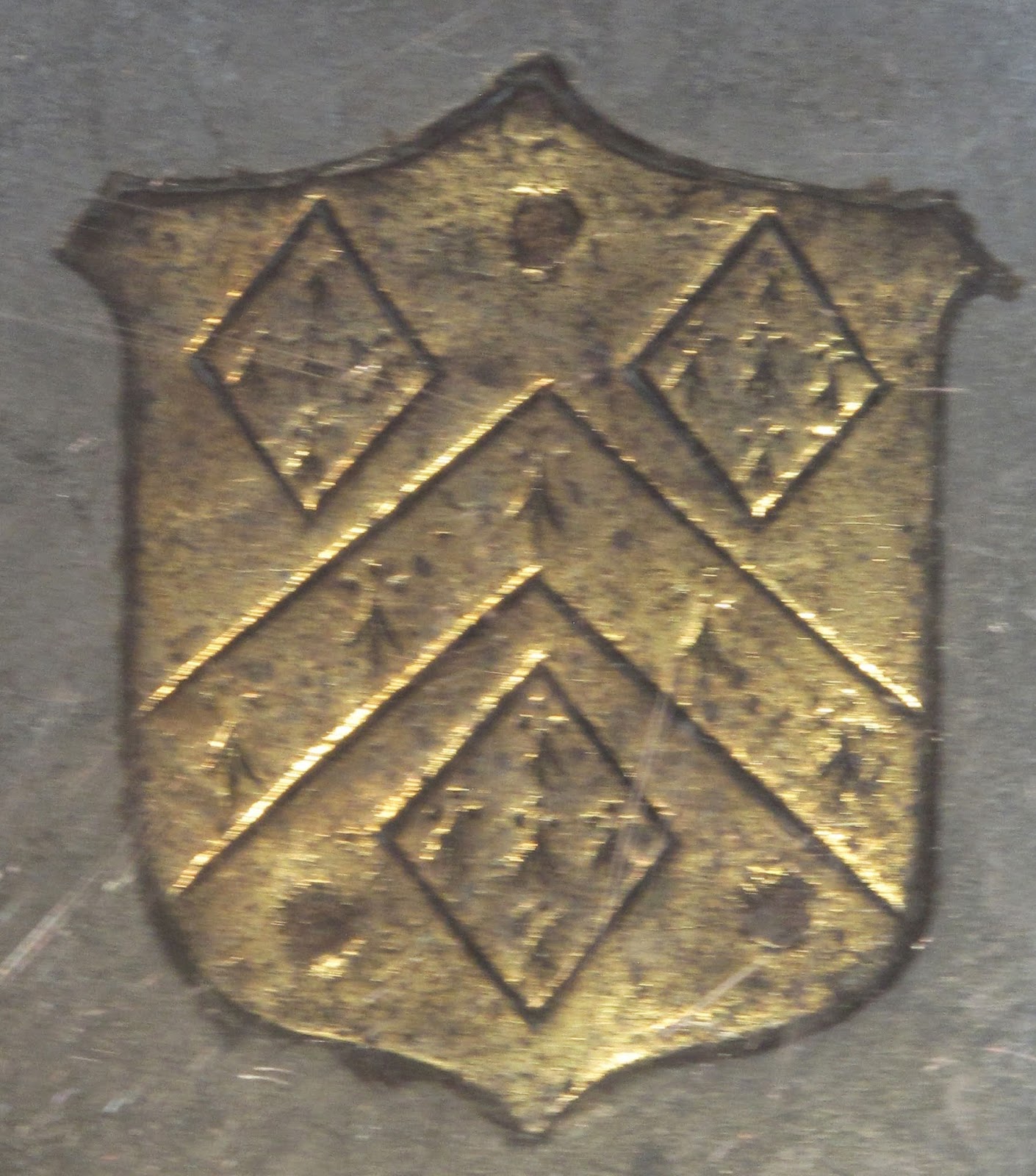
 18. Either Argent a chevron between three lozenges ermines Shaa/Shaw, or Sable a chevron between three lozenges ermine (Shaw).


19. _____ on a bend _____ three mascles _____. (Unidentified.  There are eight entries for this pattern in Papworth.  Without knowing the tinctures - please, people, is engraving proper heraldic hatching really all that difficult? - there was no way to decide to which surname this shield belongs.)


20. _____ billety _____ a fess dancetty _____. (_____ a fess dancetty between ten billets _____?) (Unidentfied.)


21. Per pale _____ and _____ all goutty _____ (counterchanged?). (Unidentified.  Papworth does give an entry for Grindoure, Per pale or and vert twelve gouttes in pale counterchanged four four and four. But as there are only eight gouttes here, and in a different arrangement, I think Grindoure is unlikely.