Monday, June 29, 2015

Where Did That Coat of Arms Come From?


A recent (June 10, 2015) article by Liz Coates on the website of the Eastern Daily Press helps to explain the origins of the current coat of arms of Great Yarmouth in England.


One might think that they are simply a variant of the various arms of the Cinque Ports (most of which dimidiate the Royal arms (red with the three lions passant guardant) with ship hulks (on the blue side), but the story here is actually a little more complex than that.

The article, entitled How did Yarmouth get its half-lion half-fish coat of arms?, notes that the arms go back to the Battle of Sluys on June 24, 1340 (675 years ago this month) when Yarmouth supplied King Edward III the majority of the ships used by him in this naval battle.  As the article goes on to note:

Afterwards hailing the contribution of men and ships from Yarmouth Edward allowed the town to half its coat of arms of three silver herrings and add his own three lions, elevating its standing and providing an arresting heraldic emblem.


Thus in several ways the battle was a key point in the town's history.

You can find out a little more of the background of the Battle of Sluys as well as some of the ways in which the town is commemorating it this year on the website of the Eastern Daily Press at
http://www.edp24.co.uk/news/how_did_yarmouth_get_its_half_lion_half_fish_coat_of_arms_1_4106429

Thursday, June 25, 2015

"Wrong" State Flags (Some With Heraldry)


There's an illustrated article on the Washington Post website by Alexandra Petri and posted on June 23, 2015 whose title really caught my eye:

Every state flag is wrong, and here is why

In the article, Ms. Petri illustrates each of the fifty state flags in the United States and then humorously pokes fun at them.  A few examples follow, beginning with my own state of Texas:


“You mean this isn’t taken yet?” Texas asked. “How is this not taken? This was literally the first thing I thought of.”

While several state flags have heraldry on them, some are more blatantly rip-offs of other heraldry.  North Dakota's flag, for example:


“Shhh, if we put a big crown on the top and write ‘NORTH DAKOTA’ on the bottom, no one will notice that we stole this entire design from the Seal of the United States.”

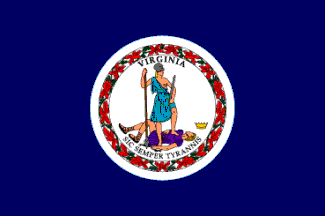
And then, of course, there's Virginia:


"Just when I thought it couldn’t get worse, Virginia happened. Virginia, do you know there’s a dead guy on your flag? 'Yeah,' Virginia says, shrugging nonchalantly. 'That’s what we do to tyrants here. Kill them, and then we pose for pictures on their corpses.' Don’t mess with Virginia."

If you'd like to see the rest of the state flags - heraldic, quasi-heraldic, and non-heraldic - along with her comments, please feel free to visit the Washington Post website at http://www.washingtonpost.com/blogs/compost/wp/2015/06/23/every-state-flag-is-wrong-and-here-is-why/


Monday, June 22, 2015

Once Again ...


... it has been shown that you can find heraldry everywhere!

It may not necessarily be accurate heraldry, but it is heraldry nonetheless. Take for example ....


This was a token to be used at a shooting gallery at the National Boy Scout Museum in Irving, Texas, where we went with one of my grandchildren the other day (because he wanted to buy a local Boy Scout Council patch).  The Museum is far larger than I had expected, and had a lot of interesting stuff to see.  And do.

One of those things was a shooting gallery with rifles which fired a laser pointer.  If you hit various targets with the red laser light, different things would happen: a can would jump, a pair of boots would "dance," a sign would spin around, and so on.

At the front desk where you paid your admission, they would give you a token to use to activate the rifle you wanted to use.  On the obverse is a rendition of the arms of the United States of America (Paly of thirteen argent and gules a chief azure).  Sort of.  The eagle, instead of supporting the shield, appears to be perched upon it; he also faces to sinister.  The shield itself consists of four "pales" rather that the paly of thirteen it should be.

As an example of the arms of the United States, I'm afraid it falls a bit short, and I have to say, along with the obverse of the token:


Wednesday, June 10, 2015

In Honor of International Heraldry Day


In honor of International Heraldry Day today, I changed my profile picture on Facebook to this shot of me wearing the only hat that I could find in Dublin, Ireland with a coat of arms on it.


The shield is, of course, the arms of Dublin.

But to think that I had to buy this to get some "wearable heraldry."  (Aside from the tie that I found there with the arms of the four provinces of Connacht, Leinster, Munster, and Ulster scattered regularly across it.)  Still, the bells hanging from the tips of the horns are a nice touch, don't you think?  Not to mention the blue braids.

It's International Heraldry Day!


What are you going to do to help celebrate the Wonderful World of Heraldry today?

Tuesday, June 9, 2015

In Honor of International Heraldry Day Tomorrow


International Heraldry Day is tomorrow, June 10, 2015, and in honor of the occasion, I thought I would repost a number of the coats of arms (and arms-like logos) that I have found in and about Dallas, Texas over the years.  So here for your viewing pleasure (or in some cases, "pleasure") are the following:


Thursday, June 4, 2015

International Heraldry Day Is Almost Here!


International Heraldry Day this year will be on Wednesday, June 10, 2015.


Why June 10?

On June 10 in the year 1128, in Rouen, was knighted by his future father in law Henry I Beauclerc, Godfrey Plantagenet.  Suspended during the ceremony on the neck of the young knight was a shield of blue decorated with six golden lions, which is recognized by most heralds as, for the first time in history, a fully-formed coat of arms.


This same shield was later borne by Geoffrey's grandson, William Longspee, which is what leads heralds to recognize it as the first true heraldry.


Heraldry was defined by the late Sir Anthony Wagner, Garter Principal King of Arms, as "the systematic use of hereditary devices centred on the shield."  Hence, its hereditary nature, descending in family lines, is an essential part of what distinguishes heraldry from being simply designs painted on shields.

So, what are you going to do to mark this special occasion?


Monday, June 1, 2015

Everything You Wanted to Know (and More) ...


... about signet rings.

I ran across a really great article the other day by J.A. Shapira entitled "The Signet Ring Primer" with a concise history of, and the use of, signet rings, both heraldic and otherwise.  Profusely illustrated.  The synopsis of the article is:

For centuries signet rings have been one form of jewelry for men serving a very productive role in society. Here we explore that role.


The article itself was posted last September; I have no excuse for not running across it sooner, except that there are only so many hours in the day, and so very much internet to be explored, that I can't get to it all as fast as I would like.

In any case, I've found it now, and am sharing it with you.

The full article, and all of its pictures, can be found on the website of Gentleman's Gazette at http://www.gentlemansgazette.com/signet-ring-primer/

Enjoy!

Thursday, May 28, 2015

Tracking Down a Coat of Arms ...


... and finding a bucket shop.

A recent correspondent enlisted my aid in trying to track down the origin of a coat of arms in an old family history book, The Crum Family in America, following a line of the family descended from a pair of brothers who emigrated from what is now Germany to Virginia in 1741.

The book illustrated the following coat of arms as belonging to the family.


My correspondent noted some unusual features in the arms, and asked my assistance in understanding the arms and trying to determine their origin.  The features which struck him as unusual were the arms of the cross ending in eagle's heads, which he had not seen anywhere else; the fact that the helm was facing forward rather than to dexter or sinister; and the armored boot as the crest.

After doing some research in some of the general and German armorials here, I responded as follows:

The cross terminating in eagle's heads is something that I've not found, either, though it is reminiscent of a "cross gringoly," a cross with each arm ending in two serpent's heads.  But even the cross gringoly is found but rarely; this variant is thus even more rare.

The barred helm being face on is actually not all that rare in German heraldry, though even there facing slightly to dexter or to sinister is more common.  Still, in my copy of Siebmacher's Wappenbuch von 1605, on the pages where each row of arms contains five shields, the helm atop the center shield in each row faces forward, while the two on the left and two on the right face in toward the center.  So it's not entirely unexpected in German heraldry to have a single shield with the helm facing forward.

The crest is unusual, in that for a boot (even an armored boot) you would normally expect it to be right side up, or "sole down".  I have seen crests of entire legs (armored and unarmored) which are upside-down (or "foot up"), but for a boot or a lower leg only, this position is very unusual.

With all that as introduction, what I suspect happened is that the author of the book found some what we call "bucket shop heraldist," someone who looks up someone's "family coat of arms" (or worse, "family crest") in their database and just spits one out, whether or not their customer is related to the original bearer of the arms or not and, if not finding an exact match in the database, grabs one from a similar surname - sometimes with modifications, sometimes without - and offers that up as the "family coat of arms" of X family.

This is not a new phenomenon; I have seen where one such heraldist in early 18th Century Boston gave his customer, surnamed Scolly, the arms of a family named Scholar.

What I think happened here is that, not finding a coat of arms for Crum, someone modified the arms and crest of a family named Crümmel de Roiff of Westphalia (listed in Rietstap's Armorial Général), whose arms are blazoned Argent a cross gringoly gules, and whose crest is A boot gules, spurred argent.  [Below is a .jpg of Crümmel de Roiff's arms taken from Rolland and Rolland's Illustrations to the Armorial Général.]  They then changed the serpent's heads to eagle's heads on the cross (or they didn't know that they were supposed to be serpent's heads, and drew them as eagle's heads), and (probably lacking an illustration) placed the boot upside down for the crest.  Presto!  The arms of Crum from Germany.  Happy customer; paid heraldist.  Win-win for everyone.  Except, of course, for those who come later and are trying to figure out where the arms came from.


So, what do you think?  Did I miss a Crum coat of arms with a cross terminating in eagle's heads, or are we dealing with another example of the bucket shop herald's work?

I know what I think.

Monday, May 25, 2015

An Artist's Dilemma


It's a long-standing dilemma for heraldic artists: Do they put pictures of their work on the internet because doing so can help to drive sales of their works, or do they not post pictures of their work on the internet because others may download those images and use them without authorization or crediting the author of the work?

Many artists do indeed go ahead and post pictures of their work on-line, because it does assist them in making sales and earning a living from their art.  But it is not uncommon that sometimes those images are found to appear on other websites or other places, without the authorization of the creator and very often with even crediting them.
A recent case in point is that of sculptor Patrick Damiaens, whose website showcasing his wonderful work is linked from this blog in the "Heraldic Artists' Websites" section down the left-hand column.  (If you haven't visited his site yet, please do so.  He's a very talented sculptor.)  A picture of a unique carving that he had made for one of his clients and posted on his website appears to have been used as the model for the design on a candle being sold in a chain of stores in Europe.  So you can decide for yourself whether or not his work was plagiarized, here's a photo comparing the design found on the candle to Mr. Damiaens' original carving:


There's a lot more to this story, of course, but rather than repeat it all here, I recommend that you go to the May 14, 2015 post entitled "Did ZARA HOME commit plagiarism?" on his blog and read the whole thing for yourself.  That post, and additional photographs, can be found at http://ornamental-woodcarver-patrickdamiaens.blogspot.be/2015/05/did-zara-home-inditex-commit-plagiarism.html

As I said, it's a dilemma for artists of all sorts, not just heraldic artists.  Do you post pictures of your work on the internet, knowing that it's probably the very best way to boost sales of your work, but also knowing that those pictures may be used by others in unauthorized ways and for which you may not even be given proper credit?